


What We Carry

Asian American Adoptees on Identity, Memory, and Belonging
Adoption is not what people think it is. I feel like people want it to be simple so badly, like they need it to make sense in a clean, comforting way. A child is “saved,” placed into a better life, and grows up grateful. That’s the version that gets told, repeated, and accepted without much questioning. But that version leaves so much out. It ignores the parts that are harder to explain—the parts that don’t fit into something neat or easy to digest.

For many Asian American adoptees, the story is not just about being chosen or being loved. It’s about everything that came before that moment, and everything that was never fully explained after. It’s about having a beginning that exists somewhere else, in a place you may not remember, shaped by circumstances you didn’t choose but still carry. There’s often a quiet awareness that your life didn’t start where you think it did, and that there are pieces of your story that may never be fully accessible to you.

What makes it more complicated is not just what happened, but what you don’t know. Not knowing your birth name, your medical history, or the full truth behind why you were placed for adoption creates a kind of absence that doesn’t just disappear. It follows you. It shows up in how you understand yourself, in how you navigate relationships, and in the way you try to make sense of an identity that was never fully handed to you in one piece. Even when you grow up in loving environments, that absence can still exist alongside it, quietly shaping how you see yourself and where you feel like you belong.

Being an Asian American adoptee often feels like existing in a constant in-between. Between cultures, between appearances and lived experiences, between what people assume about you and what actually feels true. There are moments where you feel fully grounded, and others where something feels slightly off, even if you can’t immediately explain why. It’s not always loud or obvious, but it’s there.

After speaking with Abby Hueston, Livvy Bridge, Annie Dixon, and Jordyn Livesay, I started to realize that while their stories were all completely different, there was still something shared underneath all of them. It wasn’t one specific experience or event—it was more of a feeling. A kind of understanding that doesn’t need to be explained in detail because it’s already recognized.
The Stories We Carry
Livvy: The Story You Thought You Knew
Livvy’s story made me think about how much of our identity is shaped by the version of truth we’re given, especially when we’re too young to question it. She always knew she was adopted, but the story she grew up with was simplified in a way that made it easier to understand. It centered more around her adoptive parents’ journey to China and broad explanations like the one-child policy, rather than the specifics of her own beginnings. For a long time, that version of her story was enough because it was all she had.
That changed when she was nineteen. After reconnecting with one of her birth sisters, she learned that her story was far more complex than what she had been told. She was the first of eight children, and the first three daughters, including her, were sold into the black market before eventually ending up in orphanages. The remaining children were kept and raised by their birth parents. Learning this didn’t just add new information—it completely reframed everything she thought she understood about herself.
She described how she had always believed her parents didn’t want her because she was a girl, which turned out to be only partially true and not in the way she had imagined. That kind of realization doesn’t just shift your perspective; it forces you to reevaluate your sense of identity, your worth, and the narrative you’ve carried for most of your life. At the same time, it created an opportunity for connection. She was able to meet her sister, and her adoptive parents were able to understand her story more fully.
Even with that, there’s still a weight to carrying something like that. It’s not a story that fits into a simple explanation, and it doesn’t resolve neatly. It exists in layers—truth, confusion, anger, understanding—all at once. And part of her journey now is learning how to hold all of those things without letting any single part define her entirely.
Jordyn: When You Lose the Only Thing You Knew
Jordyn’s story highlights a different kind of complexity, one that isn’t rooted in missing information but in loss. She was adopted at thirteen months old into a loving family that provided her with stability, support, and a strong foundation. That foundation shaped how she understood herself and her place in the world. But over time, that sense of stability was disrupted in a way she couldn’t control.
Her father passed away when she was six, and her mother passed away when she was sixteen. Losing both parents at such formative points in her life didn’t just mean losing family—it meant losing the framework she relied on to understand herself. When she described it that way, it made clear that identity is not something we form in isolation. It is deeply connected to the people and environments that shape us, and when those are taken away, it requires a kind of rebuilding that is both emotional and personal.
She speaks about gaining “bonus families,” people who stepped in to support her and contributed to her growth, and there is genuine gratitude in how she talks about them. But there is also an understanding that those relationships, while meaningful, do not replace what was lost. They exist alongside it.
Her experience of growing up primarily in white spaces adds another layer to her story. While she does not frame it as inherently negative, she acknowledges that it often meant navigating environments where her identity wasn’t fully understood. Over time, she has worked through those experiences and reached a place where she is actively defining herself, rather than relying on external structures to do it for her. Her story reflects both loss and resilience, not as opposites, but as things that exist together.
Abby: Living in the In-Between
Abby’s experience reflects something that is less about a single defining moment and more about a continuous feeling. She grew up in a loving family that made intentional efforts to expose her to her cultural background, and she was raised in environments that were relatively inclusive. On the surface, there was nothing that clearly signaled disconnection.
And yet, there was still a persistent sense of being in between. She described feeling too Asian to fully fit in with her white peers, but also too white to feel fully connected to her Asian identity. That kind of experience doesn’t always come from one specific event. It builds over time through small interactions—questions from others, subtle racial comments, and moments where differences become more visible than they were before.
Internally, that in-between feeling showed up in the way she navigated relationships and her sense of self. She described adapting to the people around her and not always feeling like she had a clear, grounded identity of her own. Over time, she began to recognize patterns in her behavior, including attachment-related challenges, and started to consider how early experiences—despite not being consciously remembered—may still have had an impact.
Her story challenges the idea that adoption at a very young age eliminates the possibility of lasting effects. Instead, it suggests that those effects can be more subtle, showing up in ways that take time and self-awareness to understand. Rather than trying to force a resolution, she is learning how to exist within that in-between space without needing to fully define it, which in itself is a form of growth.
Annie: Learning to Exist Without Full Answers
Annie approaches adoption from a perspective that feels grounded in acceptance, even while acknowledging the uncertainty that comes with it. She recognizes that there are aspects of her story she may never fully understand, including details about her birth family and her medical history. Even something as basic as her birthday is something that was assigned rather than known.
Instead of viewing these unknowns solely as limitations, she sees them as part of her experience—something that has shaped how she approaches life more broadly. She has learned to navigate uncertainty in a way that allows her to move forward without needing complete answers. This perspective doesn’t dismiss the significance of what is unknown, but it reflects a willingness to live with it rather than be defined by it.
She also emphasizes that her identity extends beyond adoption. Being Asian is one aspect of who she is, but it exists alongside other identities, including her experiences as a woman, a member of the LGBTQIA+ community, and an environmentalist. This layered understanding of identity highlights that adoption is not the sole defining factor, but one part of a much broader sense of self.
Her story illustrates that not all adoptee experiences are rooted in searching or resolution. Sometimes, the focus is on learning how to exist fully in the present, even when parts of the past remain unclear.
The Pieces That Bind
What stood out most across all of these stories was not just how different they were, but how they connected in underlying ways. Each person had their own experiences with race, identity, and belonging, but there was a shared understanding of navigating spaces where those things don’t always align easily.
There was also a shared experience of carrying some form of absence, whether that was missing information, loss of family, cultural disconnection, or unanswered questions. And despite those differences, each of them had developed their own way of making sense of it, building identity not from a single narrative, but from multiple, sometimes conflicting pieces.
These stories make it clear that adoption is not a one-time event. It is something that continues to evolve over time. As new information is discovered, as perspectives shift, and as individuals grow, the meaning of adoption changes with them. Some questions are answered, others remain open, but all of it contributes to the person they become.
Becoming Anyway
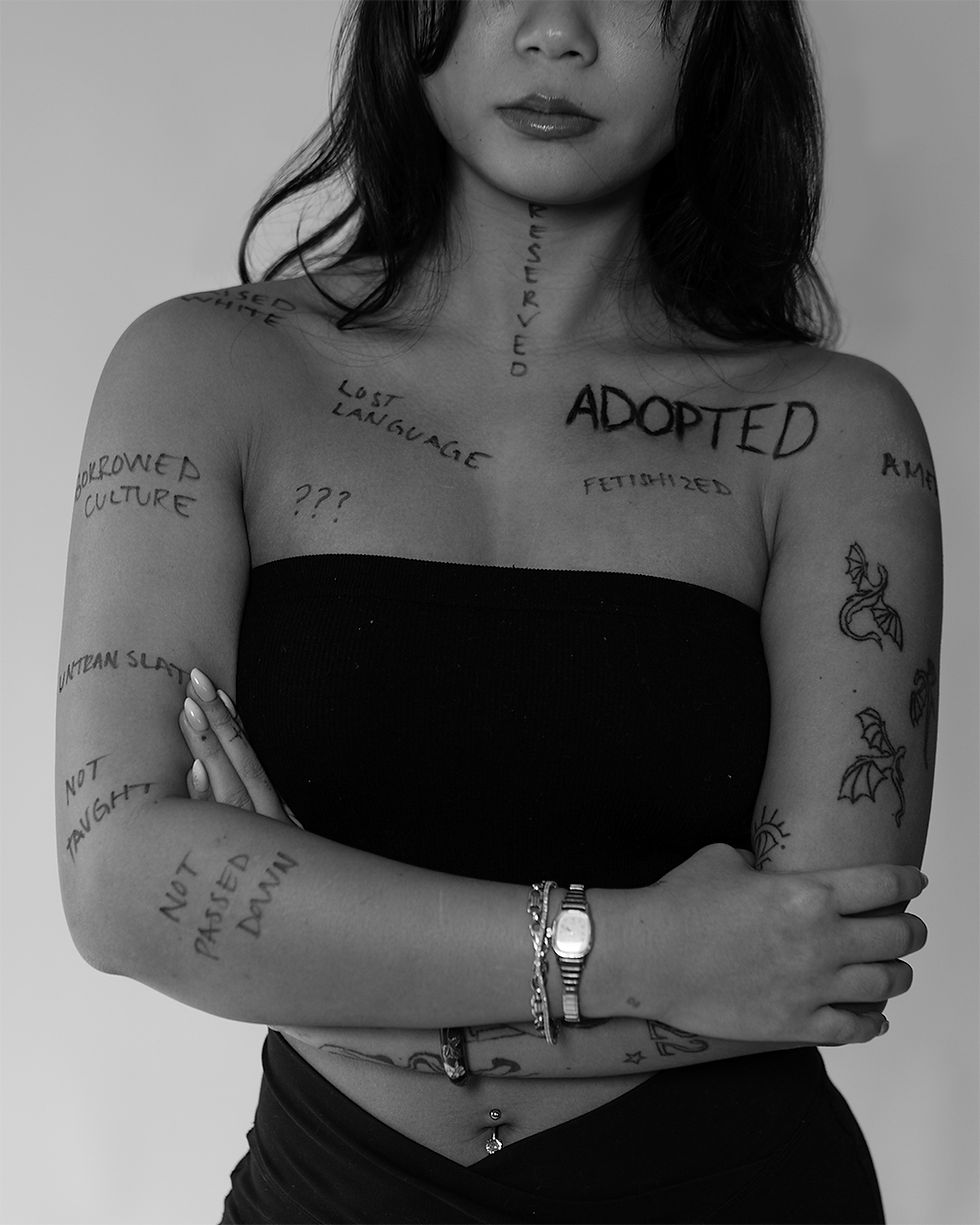
To carry these stories is to carry both weight and strength at the same time. Adoption leaves gaps, unanswered questions, and complexities that don’t always resolve. But even within that, there is growth, self-awareness, and the ability to create meaning.
These adoptees are not defined solely by what they don’t know or what they’ve lost. They are defined by how they continue to move forward, how they hold multiple truths at once, and how they build a sense of self that is not limited by incomplete narratives.
They are still becoming. Not because everything has been figured out, but in spite of the fact that it hasn’t.
Creative direction, photography and written by Kaitlyn Courtney
Featured models: Abby Hueston, Livvy Bridge, Annie Dixon, and Jordyn Livesay


Comments