


Seeing the Whole Picture: A Holistic and Collaborative Approach to Supporting Youth

Understanding context while still believing in growth and accountability
Over time, I have come to believe that supporting people well requires more than addressing a single problem; it requires stepping back to see the whole picture. In my work with youth, I often shared a phrase with them: “Explanation is not justification.” Understanding the context behind someone’s actions helps us make sense of what is happening, but it does not remove accountability. Growth happens when we are able to acknowledge both the circumstances someone is facing and their responsibility to move forward.
The balance is not always easy to hold. It requires us to slow our initial reactions and be intentional in our responses. Instead of focusing only on what is immediately visible, we have to consider what may be happening beneath the surface.
Too often, when we see someone struggling, we respond to the behavior in front of us without recognizing that it is only one piece of a much larger picture. People do not exist in isolation. Their decisions and reactions are shaped by the environments they move through every day. Family dynamics, school or career pressures, community influences, and access to support all influence how someone navigates challenges, even when those factors are not immediately visible in the moment.
When we respond without acknowledging those factors, we risk addressing the surface without understanding the root. This can lead to repeated cycles where the same behaviors continue because the underlying need has not been met. Taking the time to understand context doesn’t mean excusing behavior, but it does allow us to respond in a way that is more effective and more sustainable.
This is especially important when working with young people. Adolescence is a time when impulse control and decision-making are still developing. That reality should guide adults to respond with empathy and patience. At the same time, development does not remove the need for accountability. Young people benefit most when they feel understood while also learning how their choices affect their future.
They also benefit from consistency. When expectations are clear and responses are predictable, young people are better able to connect their actions to outcomes. When support is present alongside those expectations, it creates an environment where growth feels possible rather than out of reach.
This mindset shapes how I approach my work in the community. Supporting youth holistically requires more than one organization stepping in. Schools, mental health providers, law enforcement, families, and community organizations all play a role in helping young people navigate difficult moments. When these sectors operate in silos, young people often fall through the gaps. When they work together, stronger systems of support begin to form.
In many cases, each system is seeing a different part of the same story. A school may see changes in behavioral or academic performance. A family may be navigating challenges at home. A community organization may be providing mentorship or support. Without communication, those pieces remain disconnected. With collaboration, they begin to form a clearer picture of what a young person needs.

At Indiana Teen Treatment Center, collaboration is central to how we approach care. Rather than working in isolation, we partner with schools, community organizations, and public safety leaders to help young people access the right level of support. When one system identifies that a young person may need additional help, collaboration allows that support to be coordinated instead of fragmented.
This often begins with simple conversations: sitting down with a school team to talk through what they are seeing, connecting with a community partner who has built trust with a family, providing clarity around what services are available and when they may be appropriate. These moments may seem small on their own, but together they create pathways that make accessing care more approachable and more effective.
Collaboration also helps reduce delays in care. When systems are connected, intakes happen more smoothly, communication is clearer, and young people are able to access support before challenges escalate further. It creates a shared responsibility rather than placing the weight on one system or one moment of intervention.
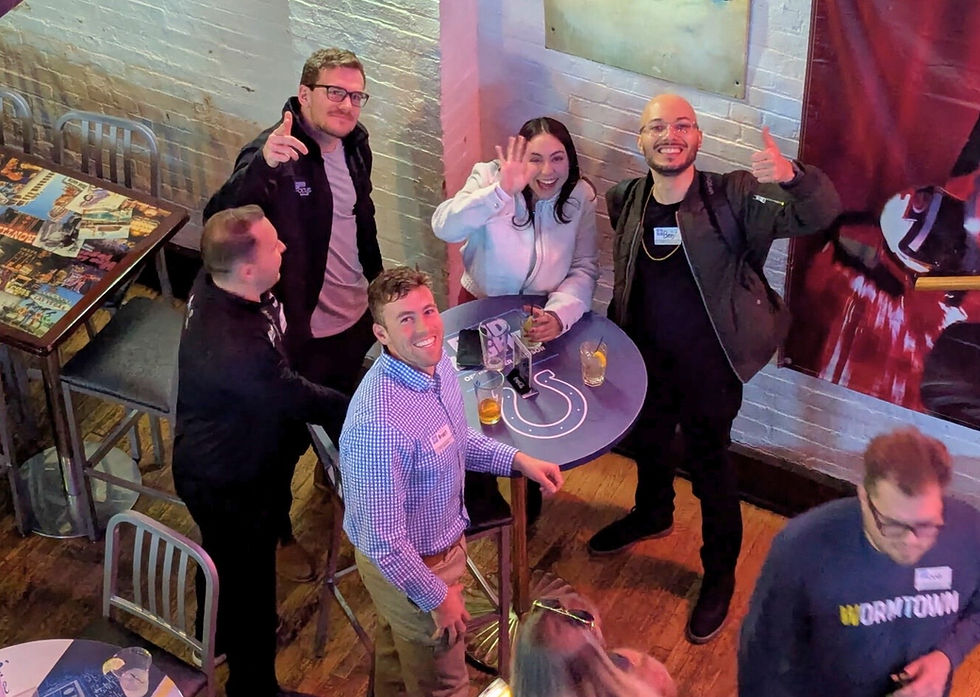
I also see the importance of these connections through my involvement with Young Professionals of Central Indiana (YPCI), where emerging leaders across different industries are working to strengthen our city and build relationships across sectors. For me, that has meant being in spaces with people who approach challenges from completely different perspectives, but are all working towards the same goal of building a stronger community.
Those relationships don’t stay in those rooms. They carry over into the workplace. When I need to connect with a partner or navigate a complex situation, I am often reaching out to someone I already know and trust. Over time, I have seen how those connections become the foundation that makes real collaboration possible and allows support to feel more connected, responsive, and intentional.
One moment that has stayed with me was working with a student who was navigating a lot at once, including a parent battling cancer. Through a connection I had made in YPCI, I was able to reach out to Little Red Door Cancer Agency and help connect that family to additional support. It was not a large-scale initiative or a formal program. It was simply knowing the right person and being able to make that connection at the right time.
Experiences like that continue to reinforce how important it is for systems and people to stay connected. When those relationships exist, support becomes more accessible, more responsive, and more aligned with what someone actually needs in the moment.
That same mindset extends beyond individual moments and into how larger systems work together to support young people. One example of this approach taking shape in our community is the partnership between Indiana Teen Treatment Center and the Indianapolis Metropolitan Police Department to help bring back the Youth Crisis Intervention Team program. Programs like CIT Youth focus on education, mental health awareness, and strengthening relationships between young people and the systems that support them. Efforts like this show what can happen when sectors come together with a shared goal of supporting youth well.
This work is not just about responding in moments of crisis. It is about building understanding ahead of time. It is about equipping adults with the tools to recognize what may be happening beneath the surface and respond in a way that prioritizes safety, connection, and appropriate next steps. It also creates opportunities for young people to experience these systems as supportive rather than solely corrective.
Serving our community holistically begins with recognizing that no single system holds the full solution. It requires collaboration, communication, and a willingness to look beyond one moment in time. It also requires consistency in how we show up. Real support is not built in one interaction, but through relationships, follow-through, and shared responsibility across the people and systems involved.

Seeing the whole picture means believing that young people are capable of growth and building communities strong enough to support and guide that growth. It means holding both accountability and understanding at the same time. It also means creating environments where young people are not defined by one moment but supported through what comes next. When communities take this approach, young people gain more than support. They gain the guidance, expectations, and opportunities needed to move forward with clarity and confidence.
Photo courtesy of and written by Katelyn Munoz



The article answered several basic questions in a fairly natural way, and I liked that the explanations did not feel rushed. The information was arranged neatly enough that I could go back to a particular point without losing track of what was being discussed. I also noticed that the practical side of the topic received reasonable attention. I happened to come across igrs ec search today while checking a related reference, and it reminded me that finding older records can sometimes be confusing when you are not familiar with the process. I am curious whether the search results are usually easy to interpret for first-time users. A few examples might make that part easier to understand.
I found myself reading this from beginning to end without skipping around because the explanation stayed clear throughout. The examples kept everything connected, and nothing felt unnecessarily complicated. A little later I came across mparivahan citizen while checking something similar, and it fit naturally with one of the ideas discussed here. I wonder if there are any common mistakes people usually make that could be included in a future update.
I appreciated how each section answered a question before moving to the next one. That made the whole piece feel more natural instead of packed with unnecessary details. I also noticed Parivahan Sewa solutions while browsing through a related topic afterward, and it reminded me of one example from this article. It might be useful to include a short checklist at the end for readers who want a quick recap before leaving the page.